
Do Legal Rules have DNA? Or, phrased more generally, can we deconstruct legal rules into combinations of basic building blocks? Legal scientists (or ‘jurists’) have been searching for these elements for several centuries. Each phase of investigation reveals a different metaphor for the legal system. In the 19th and early 20th centuries, jurists thought in terms of ‘elements’ and ‘encyclopaedias’; in the late 20th and early 21st they thought in terms of DNA, genes, and taxonomy.
The first serious attempt was by a German jurist by the name of Georg Friedrich Puchta in 1856. Like many 19th century Germanic legal scientists, Puchta believed law was comprised of a finite set of elementary concepts, e.g. persons, interests, rights, duties, powers, property, sanctions, and remedies, which jurists analyse and recombine to construct the rules governing any behaviour:
Just as a limited set of letters can generate an unlimited range of words, a small set of legal concepts could be used to generate any legal rule. To take a basic example of his method, consider a simple rule like ‘transfer of property ownership’ (conveyance):
Colloquial: I sell my house to you and now it’s yours.
Scientific reconstruction:
Legal Person A, possessing Legal Capacity, has the Right of Property (freehold) over a Thing (house). A, exercising his Will, makes an Agreement (contract) with Legal Person B, who also possesses Capacity. A thereby exercises his Power to transfer that Right (freehold) to B and to create new Rights and Duties according to the Agreement.
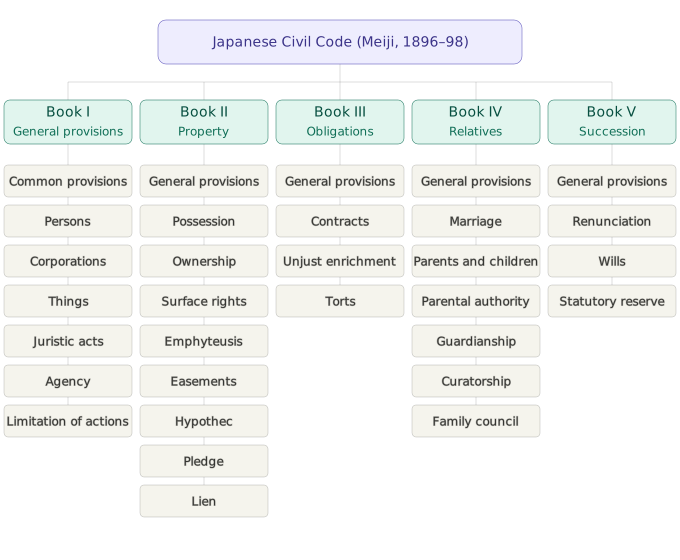
Puchta described his method as “legal chemistry”: the systematic fusion and transformation of concepts to produce new legal arrangements. His aim was a complete register of legal elements, analogous to a periodic table or encyclopaedia. The definition was not functional but systematic: according to Jhering, an element ‘“could stay unused for a century”, awaiting future conditions where it might be called to action. Despite this spooky metaphysics, the German jurists used their skills in a very practical way: codifying the law of the newly unified German Empire. Their methods reached completion in the 1900 German Bürgerliches Gesetzbuch code, prefaced by a general part setting out the elements common to the whole of civil law. This code and its basic logic was quickly replicated across the world:
Puchta’s designs fell into obscurity following the Second World War and the rise of socially-conscious legal theories. For over a century they languished in obscurity until, in the dusty libraries of Oxford, a brilliant and somewhat mad don ressurected them. Peter Birks, like Puchta, had deeply studied Roman Law and believed it held the key to the organisation of law. But rather than composing a periodic table or encyclopaedia, Birks turned to biological classification for inspiration:
Since Watson and Crick discovered the structure of DNA it has become possible to show that... the Linnaean classifications were no more than the best available hypotheses; and that there are now better available hypotheses. It would be sheer madness wilfully to stick to a hypothesis which has been bettered, still madder to stick to it here and abandon it there, to stick to it in forestry while teaching in botany that it had been superseded. It is in the nature of competing classifications, like all competing hypotheses, to fight to the death.
Both Birks and Puchta were confronted by a vast, disorganised mass of domestic law. Puchta faced the plethora of regulations produced haphazardly throughout the German states, and Birks in turn was presented with the inherited pile of ‘good learning’ of the English common law. In response, most English jurists – then and now – abandoned classification. They allow law to grow mostly undirected, sorted occasionally by a private treatise. Such treatises, however, are produced by private scholars and their multitude creates a sort of free market in legal taxonomizing. Indeed, it was this organic process which led both Hayek and James C. Scott to regard the common law as an example of a bottom-up, metis-based order.
Birks disagreed. He believed the ‘pile of good sense’ was confused and contradictory, akin to sorting animals into those which "are herbivores, carnivores, yellow, or eat other things.” His solution was a top-down, rational taxonomy. We must do as the zoologists do: find the fundamental elements of law inherent in their nature. Characterising Birks as a high modernist is therefore an error; like Puchta his plan was not political but scientific. He merely sought to carve legal reality at its joints.
He believed law – specifically private law – was comprised of what he called “causative events.” For example, you and I agree to trade our watches; I wrongfully injure you in a car crash; or perhaps you receive unjustified enrichment from my mistaken payment. These events create obligations and corresponding duties between pairs of legal subjects. Respectively, they elements are sorted into contract, tort, and unjustified enrichment. Together they form the ‘law of obligations’, which are a subset of ‘private law, a subset of ‘substantive law’, ‘national law’, and then finally ‘law’ in general, thus completing the phylogenetic tree:
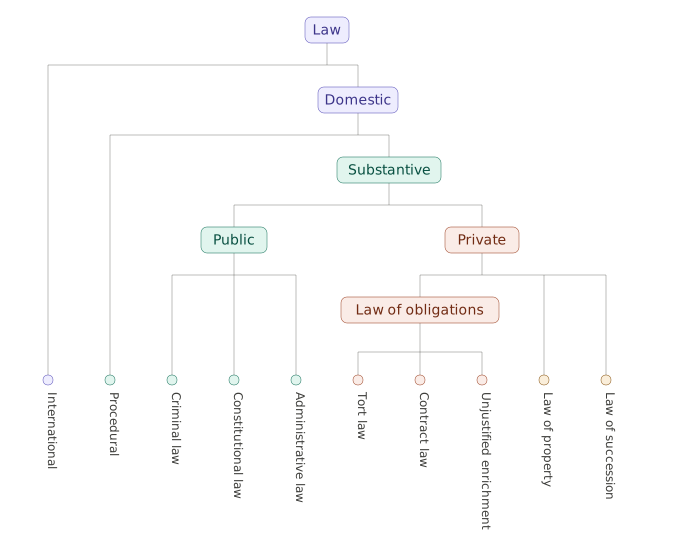
For most readers this will seem absurdly abstract and empirically dubious. Nevertheless, these buildings blocks successfully describe the private law of virtually every nation on the planet. The Chinese Civil Code of 2020; the Japanese Meiji Code of 1896; the Turkish Civil Code of 1926: all contain Puchta’s elements and Birks’s tree. Each models the Human as an abstract individual with the power of contract, the rights of property, and the will to secure his interests.
The only exceptions are those systems which lack industrial capitalism altogether: the feudal legal systems; customary law; religious orders; the Soviet, East German, and North Korean people's courts. Democracy is irrelevant. When Fascist Italy and Nazi Germany permitted industrial markets, and the Russian Socialist Federated Soviet Republic ran its New Economic Policy, they condemned the 'degenerate' and 'materialistic' laws of capitalism. Yet once high-volume trading commenced, and disputes emerged, the basic legal elements returned.
Our legal rules continue to evolve and new juridical taxonomies are required. Today few legal taxonomists continue the great program and law grows unmanageably complex. AI offers a tantalising, if arcane, promise: simulate hypothetical cases derived from social conditions and evolve the law in response. Puchta’s own mentor von Jhering once dreamed of this possibility: in a wiser, more advanced age, ‘we shall calculate with our concepts.’ The only wrinkle is that, as with all hyper-scaled human activities, our new taxonomic concepts may cease to be human-readable.
If so, we will be presented with the same mystery as the 11th century medieval jurists who first rediscovered Roman law: an alien technology descends from heaven, far superior to anything we have produced today. All that we can do is scrutinise its internal workings, hoping that its promises of perfect consistency and justice are true. One day, in a thousand years, the taxonomy will be perfected, and thus the next phase of the cycle can begin.